

Last Updated: September 17, 2026
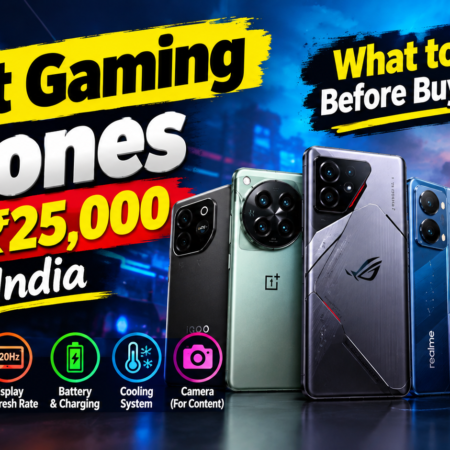
Gaming smartphones under ₹25,000 have become significantly more capable in India.
A few years ago, buyers had to spend considerably more to get a phone with a powerful chipset, high-refresh-rate AMOLED display, large battery and fast charging.
Today, the ₹25,000 segment includes phones with performance-focused processors, 120Hz or higher displays, large batteries, fast charging and gaming-oriented features.
However, choosing a gaming phone is not as simple as checking the processor name.
A phone may have a powerful chipset but perform poorly during long gaming sessions because of heat. Another phone may have an excellent display but a weaker GPU. A third phone may have a large battery but slow charging.
For gaming, you need to evaluate the complete system.
This guide explains what matters when buying a gaming smartphone under ₹25,000 in India in 2026 and examines several current options based on publicly available specifications and market information.
Important: This is a research-based buying guide. NextGadgetz has not claimed hands-on testing of every smartphone mentioned. Prices and availability can change frequently.
Best Gaming Phones Under ₹25,000: Quick Comparison
| Smartphone | Approx. Price | Processor | Display | Battery | Charging | Best For |
|---|---|---|---|---|---|---|
| POCO X7 Pro 5G | ₹23,999 | Dimensity 8400 Ultra | 1.5K AMOLED, 120Hz | 6,550mAh | 90W | High-performance gaming |
| Realme P4 5G | ₹20,999 | Dimensity 7400 Ultra | AMOLED, 144Hz | 7,000mAh | 80W | Gaming + battery |
| Infinix GT 30 5G | ~₹22,000 | Dimensity 7400 | AMOLED, 144Hz | 5,500mAh | 45W | Gaming-focused features |
| OPPO K13 5G | ₹21,999 | Snapdragon 6 Gen 4 | AMOLED | 7,000mAh | 80W | Battery-heavy gaming |
| vivo T4 | ₹24,999 | Snapdragon 7s Gen 3 | AMOLED, 120Hz | 7,300mAh | 90W | Long gaming sessions |
| Motorola Edge 60 Fusion | ~₹20,900 | Dimensity 7400 | P-OLED, 120Hz | 5,500mAh | 68W | Balanced performance |
Prices are approximate market prices and may vary by storage configuration, retailer, offers and bank discounts.
1. POCO X7 Pro 5G
The POCO X7 Pro 5G is one of the most performance-oriented phones available around the ₹25,000 price point.
Its biggest attraction for gamers is the MediaTek Dimensity 8400 Ultra chipset.
The phone also combines the processor with LPDDR5X RAM and UFS 4.0 storage on the listed 8GB + 256GB configuration.
That combination matters because gaming performance isn’t determined only by the processor.
Fast storage and sufficient RAM can also contribute to a smoother overall experience.
Key specifications
- MediaTek Dimensity 8400 Ultra
- 8GB RAM
- 256GB storage
- 6.67-inch 1.5K AMOLED display
- 120Hz refresh rate
- 6,550mAh battery
- 90W charging
- 50MP primary camera
- 8MP ultrawide camera
- 20MP front camera
The phone is currently listed around ₹23,999 in the Indian market.
Why gamers may consider it
The combination of:
Dimensity 8400 Ultra + LPDDR5X + UFS 4.0 + 120Hz AMOLED
makes this phone particularly interesting for users who prioritise performance.
The 1.5K resolution also makes games and videos look sharper than a basic Full HD panel.
Things to consider
Higher display resolution can consume more power.
Gamers who want maximum battery endurance may sometimes prefer using lower graphics or frame-rate settings rather than always pushing the display and GPU to their maximum.
2. Realme P4 5G
The Realme P4 5G takes a slightly different approach.
It combines a Dimensity 7400 Ultra chipset with a 144Hz AMOLED display and a large 7,000mAh battery.
The high refresh-rate display can make supported games and general scrolling feel smoother.
Key specifications
- MediaTek Dimensity 7400 Ultra
- Up to 8GB RAM
- Up to 256GB storage
- 6.77-inch AMOLED display
- 144Hz refresh rate
- 7,000mAh battery
- 80W charging
- 50MP main camera
- 8MP ultrawide camera
- 16MP front camera
Why it is interesting for gamers
The 7,000mAh battery is particularly useful for people who spend long periods away from a charger.
The 144Hz display also gives the phone a high-refresh-rate advantage.
But there is an important point:
A 144Hz display does not mean every game will run at 144 frames per second.
The game’s frame-rate support, chipset capability, graphics settings and thermal conditions all matter.
3. Infinix GT 30 5G
The Infinix GT series has traditionally been positioned toward performance-focused users.
The GT 30 5G combines a Dimensity 7400 chipset with a 144Hz AMOLED display.
It also includes gaming-oriented design elements and features intended to make the phone more attractive to mobile gamers.
Key specifications
- MediaTek Dimensity 7400
- 8GB RAM
- 128GB storage in the commonly listed configuration
- 6.78-inch AMOLED display
- 144Hz refresh rate
- 5,500mAh battery
- 45W charging
- 64MP primary camera
- 8MP ultrawide camera
- 13MP front camera
The phone is available around the ₹22,000 range depending on the configuration and current offer.
Who should consider it?
It can make sense for users who want:
- Gaming-oriented styling
- High-refresh-rate AMOLED
- Good mid-range performance
- Gaming features
- Large display
One limitation
Its 5,500mAh battery is smaller than some competitors offering 7,000mAh or more.
If you regularly play for several hours without access to a charger, battery capacity becomes an important consideration.
4. OPPO K13 5G
The OPPO K13 5G is another interesting option under ₹25,000.
Its major strength for gaming is the combination of:
- Snapdragon 6 Gen 4
- 7,000mAh battery
- AMOLED display
- 80W charging
Key specifications
- Snapdragon 6 Gen 4
- Up to 8GB RAM
- Up to 256GB storage
- 6.67-inch AMOLED display
- 7,000mAh battery
- 80W SuperVOOC charging
- 50MP main camera
- 2MP secondary camera
- 16MP front camera
The phone is listed around ₹21,999.
Who should consider it?
The K13 makes more sense for someone who wants gaming capability combined with strong battery endurance.
The large battery can be particularly useful for:
- Long gaming sessions
- Video streaming
- Navigation
- Social media
- Heavy daily use
What to remember
Battery capacity does not directly equal gaming performance.
A large battery can extend the time between charges, but the chipset and thermal system still determine how well demanding games run.
5. vivo T4
The vivo T4 is one of the more interesting battery-focused options in this category.
It features a Snapdragon 7s Gen 3 chipset and a massive 7,300mAh battery.
It also supports 90W charging.
Key specifications
- Snapdragon 7s Gen 3
- 8GB RAM
- 128GB storage
- 6.77-inch AMOLED display
- 120Hz refresh rate
- 7,300mAh battery
- 90W charging
- 50MP primary camera
- 2MP secondary camera
- 32MP front camera
The phone is listed around ₹24,999.
Why gamers may like it
The combination of:
Snapdragon 7s Gen 3 + 7,300mAh + 90W charging
makes the phone attractive for users who prioritise battery endurance.
For people who play games during travel or long periods without a power outlet, battery capacity can be as important as raw benchmark performance.
6. Motorola Edge 60 Fusion
The Motorola Edge 60 Fusion is not marketed exclusively as a gaming phone, but its specifications make it relevant to gamers.
It uses the Dimensity 7400 processor and features a 120Hz P-OLED display.
Key specifications
- MediaTek Dimensity 7400
- 8GB RAM
- 128GB storage
- 6.67-inch P-OLED display
- 120Hz refresh rate
- 5,500mAh battery
- 68W charging
- 50MP primary camera
- 13MP ultrawide camera
- 32MP front camera
Its current market price can be around ₹20,900 depending on the seller and offer.
Who should consider it?
The Edge 60 Fusion is more suitable for someone who wants a phone that handles gaming while also providing:
- Good display quality
- Camera versatility
- Premium-looking design
- Fast charging
- Everyday usability
It may not be the first choice for someone whose only priority is maximum gaming performance.
What Makes a Good Gaming Phone?
A gaming phone needs more than a fast processor.
There are at least eight major factors you should evaluate.
1. Processor
The chipset is one of the most important components.
For gaming, look at:
- CPU performance
- GPU performance
- Manufacturing process
- Sustained performance
- Thermal efficiency
The GPU is especially important because it handles much of the graphical workload.
2. GPU
Many buyers look only at the Snapdragon or Dimensity model number.
Instead, you should also consider the GPU architecture.
Two processors may have similar CPU performance but very different gaming performance because their GPUs differ.
For gaming, GPU capability affects:
- Graphics quality
- Frame rates
- Effects
- Resolution
- Texture quality
Therefore, benchmark results can be useful, but they should not be the only deciding factor.
3. Sustained Performance
This is one of the most overlooked factors.
A phone might produce excellent performance for the first few minutes of a game.
But during a long session, the phone generates heat.
If temperatures rise too much, the system may reduce performance to control heat.
This is called thermal throttling.
As a result:
Short benchmark performance ≠ long gaming performance.
For serious gamers, sustained performance matters.
4. Cooling System
A gaming smartphone needs to move heat away from the processor.
Manufacturers may use:
- Vapour chambers
- Graphite layers
- Copper components
- Thermal interface materials
- Multi-layer cooling systems
A larger cooling system can help maintain performance during demanding workloads.
However, manufacturers use different testing methods, so cooling claims should not be treated as directly comparable unless the testing conditions are the same.
5. Display Refresh Rate
Modern phones commonly offer:
- 90Hz
- 120Hz
- 144Hz
A higher refresh rate can make animations and supported games appear smoother.
But remember:
Display refresh rate and game frame rate are different things.
A 144Hz screen does not automatically make a game run at 144 FPS.
The game must support the higher frame rate, and the processor/GPU must be capable of rendering it.
6. Touch Response
For competitive games, touch response can be important.
Games such as:
- BGMI
- Call of Duty: Mobile
- Free Fire
- PUBG Mobile
- Asphalt
- racing games
- multiplayer shooters
can benefit from responsive touch input.
A high refresh rate is useful, but touch responsiveness is another specification worth checking.
7. Battery
Gaming consumes considerably more power than light tasks such as messaging or browsing.
A larger battery can provide longer gaming sessions.
The phones in this price category increasingly offer batteries between approximately 5,000mAh and 7,300mAh.
Some models go even higher.
But battery size alone doesn’t determine endurance.
Efficiency depends on:
- Processor
- Display resolution
- Brightness
- Refresh rate
- Network connection
- Game settings
- Temperature
8. Charging Speed
Fast charging is particularly useful for gamers.
For example, if a phone supports 80W or 90W charging, a relatively short charging period can add significant battery capacity.
However, charging speed can vary depending on:
- Charger
- Cable
- Battery temperature
- Battery level
- Software limits
Repeatedly gaming while charging can also generate additional heat.
AMOLED vs LCD for Gaming
Both technologies can work well, but AMOLED generally provides some advantages for gaming and entertainment.
AMOLED advantages
- High contrast
- Deep blacks
- Vibrant colours
- Fast response characteristics
- Premium viewing experience
LCD advantages
- Often cheaper
- Can still provide high refresh rates
- Good for budget-focused phones
If two phones have similar performance and one has a high-quality AMOLED panel at a similar price, the AMOLED model may provide a more premium gaming and multimedia experience.
But display quality should be considered together with processor performance.
120Hz vs 144Hz: Does It Really Matter?
This is a common marketing question.
A 144Hz display refreshes more frequently than a 120Hz display.
However, the practical difference between 120Hz and 144Hz is relatively small compared with the difference between 60Hz and 120Hz.
For most users:
120Hz is already very smooth.
Therefore, don’t buy a phone solely because it has 144Hz.
A phone with:
- better processor
- better cooling
- better battery
- faster storage
may provide a better gaming experience despite having a 120Hz screen instead of 144Hz.
8GB vs 12GB RAM for Gaming
RAM is important, but more RAM isn’t automatically better.
For most gamers, 8GB RAM can be sufficient for normal gaming and multitasking.
12GB can be useful if you:
- Keep many apps open
- Switch frequently between games and other apps
- Use demanding applications
- Want additional multitasking headroom
But the difference between 8GB and 12GB RAM may be less important than choosing a substantially better chipset.
If your budget is ₹25,000, it can often make more sense to prioritise:
better processor + faster storage + good cooling
over simply buying the highest RAM configuration.
128GB vs 256GB Storage for Gamers
Games are becoming larger.
A modern smartphone may need to store:
- Games
- Updates
- Maps
- Photos
- Videos
- Screen recordings
- Social-media apps
Therefore, 256GB can be a comfortable choice for heavy users.
If you regularly install several large games, 128GB can become restrictive.
Also check the storage technology.
For demanding applications, faster storage can contribute to quicker loading and better overall responsiveness.
Should You Buy a Dedicated Gaming Phone?
Not necessarily.
A gaming-focused phone can provide:
- Better cooling
- Gaming software
- High refresh rate
- Performance modes
- Trigger features
- Gaming-oriented design
But a normal smartphone can also provide excellent gaming performance.
For example, the POCO X7 Pro, Realme P4 and Motorola Edge 60 Fusion show that mainstream phones can offer strong performance without looking like dedicated gaming devices.
Your decision should depend on how seriously you game.
Best Gaming Phone for Different Types of Users
For Maximum Performance
Look at phones using higher-performance chipsets such as the Dimensity 8400 Ultra class.
The POCO X7 Pro is particularly interesting in this category.
For Long Gaming Sessions
Prioritise:
- 7,000mAh-class battery
- Efficient processor
- Fast charging
- Good thermal management
The vivo T4, Realme P4 and OPPO K13 are worth examining.
For Gaming + Camera
If you want a gaming phone that is also useful for photography, don’t automatically choose the most gaming-focused model.
Look at the complete camera system.
The Motorola Edge 60 Fusion, for example, combines performance hardware with a 50MP primary and 13MP ultrawide camera.
For Gaming + Entertainment
A good AMOLED or P-OLED display can make a major difference when you also watch:
- YouTube
- Netflix
- Movies
- Sports
- Reels
In this situation, display quality can be nearly as important as gaming performance.
Gaming Phone Buying Mistakes
Mistake 1: Buying based only on AnTuTu
Benchmark scores can be useful for comparison, but they don’t completely represent long gaming sessions.
Mistake 2: Ignoring heat
A phone that becomes extremely hot during gaming may reduce performance.
Mistake 3: Buying only because of 144Hz
The game must support high frame rates.
Mistake 4: Ignoring storage
Large games can quickly consume 128GB.
Mistake 5: Ignoring charging
If you game frequently, fast charging can make everyday use much more convenient.
Mistake 6: Assuming a large battery guarantees long gaming
Display, chipset efficiency and software optimisation also matter.
Mistake 7: Ignoring the display
A powerful processor paired with a poor display can reduce the overall gaming experience.
How to Test a Gaming Phone Before Buying
If you have an opportunity to try the phone physically, don’t just open the settings menu.
Instead:
Step 1
Play a demanding game for at least 20–30 minutes.
Step 2
Check whether the frame rate remains stable.
Step 3
Check how hot the phone becomes around the processor area.
Step 4
Check touch responsiveness.
Step 5
Check whether the display remains bright enough.
Step 6
Check battery consumption.
Step 7
Check whether performance modes are available.
Step 8
Check whether the phone becomes uncomfortable to hold.
This kind of real-world test can tell you more than a single benchmark score.
Gaming Phone Checklist Before Purchase
Before ordering a gaming phone under ₹25,000, check:
- Processor
- GPU
- Cooling system
- Sustained performance
- Display refresh rate
- Touch response
- AMOLED/P-OLED/LCD type
- Battery capacity
- Charging speed
- RAM
- Storage capacity
- Storage type
- 5G support
- Wi-Fi capability
- Stereo speakers
- Headphone support if important
- Software support
- Weight and thickness
- Current price
- Warranty
Frequently Asked Questions
Which is the best gaming phone under ₹25,000?
There is no single specification that makes one phone ideal for every gamer.
For a performance-focused buyer, the POCO X7 Pro is worth examining because of its Dimensity 8400 Ultra chipset and fast memory/storage combination.
For long battery life, phones such as the vivo T4, Realme P4 and OPPO K13 offer very large batteries.
The correct choice depends on whether your priority is maximum performance, battery life, display quality or overall balance.
Is 8GB RAM enough for gaming?
For most mobile gaming, 8GB RAM is sufficient.
A faster processor and better cooling can be more important than simply increasing RAM from 8GB to 12GB.
Is 120Hz enough for gaming?
Yes.
A 120Hz display can provide a very smooth gaming experience.
A 144Hz display can provide additional smoothness in supported games, but the difference is much smaller than moving from 60Hz to 120Hz.
Is 256GB storage better for gamers?
For heavy gamers, 256GB is generally more comfortable because modern games and updates can consume substantial storage.
Does a bigger battery mean better gaming?
Not necessarily.
A larger battery can provide longer endurance, but gaming performance also depends on the processor, GPU, display, cooling and software optimisation.
Is liquid cooling necessary in a gaming phone?
Not necessarily.
Manufacturers use different cooling designs, including vapour chambers and other thermal materials.
The important factor is how effectively the complete thermal system maintains performance under sustained load.
Can a normal phone be used for gaming?
Absolutely.
You don’t necessarily need a dedicated gaming phone.
Many mainstream smartphones now have processors and displays capable of handling demanding games.
Final Buying Advice
A ₹25,000 gaming phone in 2026 can offer considerably more performance than a typical budget smartphone.
But don’t choose your phone by looking at only one specification.
For gaming, the most important combination is:
Processor + GPU + Cooling + Display + Battery + Charging + Storage
If raw performance is your highest priority, look closely at phones using stronger performance-oriented chipsets.
If you play for several hours at a time, battery capacity and thermal management become more important.
If you also watch movies and videos, choose a good AMOLED or P-OLED display.
If you install several large games, 256GB storage can be much more convenient.
And if you want a phone that works well for gaming as well as everyday photography and productivity, consider the complete specification sheet rather than buying a phone marketed purely as a gaming device.
The biggest lesson is simple:
A good gaming phone is not necessarily the phone with the highest benchmark score. It is the phone that can deliver smooth, consistent performance for the way you actually use it.
Research & Editorial Note
This article is a research-based smartphone buying guide prepared using publicly available specifications and current Indian market information.
NextGadgetz has not claimed hands-on testing of every smartphone discussed in this article.
Gaming performance can vary depending on game version, graphics settings, software version, room temperature, network conditions, battery level and device configuration.
Prices can also change because of retailer offers, bank discounts, exchange bonuses and RAM/storage variants.
Readers should verify the current price, exact configuration, warranty and availability before purchasing.
Performance • Battery • Display • Cooling

Other Articles

AMOLED vs LCD: Which Smartphone Display Should You Choose in 2026?
Best Camera Phones Under ₹30,000 in India: What Actually Matters in 2026

No Comment! Be the first one.