

Last Updated: September 17, 2026
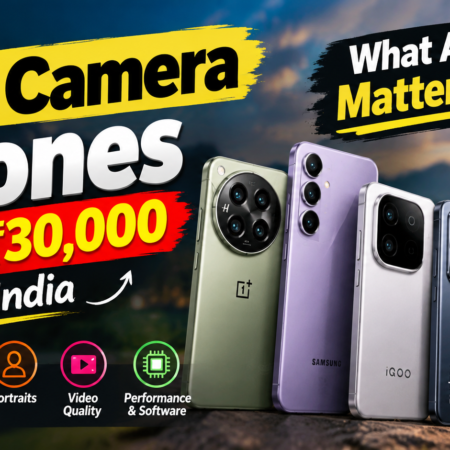
Buying a camera phone under ₹30,000 in India is no longer just about finding the highest megapixel number.
Phones in this price range now offer features such as optical image stabilisation (OIS), dedicated telephoto cameras, large camera sensors, high-resolution selfie cameras, ultrawide lenses and advanced computational photography.
But there is an important catch: a 200MP camera does not automatically mean better photos than a 50MP camera.
Sensor size, OIS, lens quality, image processing, autofocus, dynamic range and video stabilisation can have a much bigger impact on the final photograph.
This guide looks at some of the most relevant camera-focused smartphones available around the ₹30,000 budget in India in 2026. It is designed as a research-based buying guide, not a hands-on camera test.
Important: Prices mentioned in this article are reference prices and can change because of bank offers, exchange discounts, sales and storage variants. Always check the exact variant and current selling price before purchasing.
Best Camera Phones Under ₹30,000 in India: Quick Comparison
| Smartphone | Approx. Starting Price | Main Camera | Other Cameras | Front Camera | Best For |
|---|---|---|---|---|---|
| Redmi Note 15 Pro 5G | ₹29,999 | 200MP | 8MP ultrawide | 20MP | High-resolution photography |
| Vivo V60e | ₹29,999 | 200MP OIS | 8MP ultrawide | 50MP AF | Portraits & selfies |
| Motorola Edge 70 Fusion | ₹26,999 | 50MP | 13MP ultrawide | 32MP | Balanced photography |
| Samsung Galaxy F70 Pro 5G | ₹25,999 | 50MP OIS | 5MP ultrawide + 2MP macro | 12MP | Samsung users & everyday photos |
| Nothing Phone 3a Pro | ₹27,999 | 50MP | 50MP telephoto + 8MP ultrawide | 50MP | Portraits & optical zoom |
Prices are reference launch/listed prices and may vary by configuration and offers.
1. Redmi Note 15 Pro 5G
The Redmi Note 15 Pro 5G is one of the most interesting options for buyers who specifically want a high-resolution primary camera.
Its main rear camera uses a 200MP sensor, while the phone also includes an 8MP ultrawide camera.
The main sensor is relatively large for this segment, with a stated 1/1.4-inch sensor size. That matters because sensor size can influence how much light the camera can capture.
The phone also features a large 6.83-inch 1.5K AMOLED display with a 120Hz refresh rate.
Camera setup
- 200MP primary camera
- 8MP ultrawide camera
- 20MP front camera
Other specifications
- MediaTek Dimensity 7400-Ultra
- Up to 8GB RAM
- Up to 256GB storage
- 6,580mAh battery
- 45W wired charging
- 6.83-inch 1.5K AMOLED display
- 120Hz refresh rate
The listed Indian price for the 8GB + 128GB version is ₹29,999.
Who should consider it?
The Redmi Note 15 Pro makes sense for buyers who want:
- A high-resolution main camera
- A large display
- A large battery
- Detailed daylight photographs
- Plenty of storage
- A phone primarily focused on the main camera rather than telephoto photography
What to remember
The 200MP number should not be the only reason to purchase this phone.
For portraits and distant subjects, a dedicated telephoto camera can sometimes be more useful than simply having a higher-resolution primary sensor.
2. Vivo V60e
The Vivo V60e is particularly interesting for people who care about portraits and selfies.
It features a 200MP primary rear camera with OIS, an 8MP ultrawide camera and a 50MP autofocus selfie camera.
The combination of OIS and a high-resolution main sensor makes the camera hardware particularly interesting on paper.
The 50MP front camera is also notable for users who regularly take selfies, record social-media videos or make video calls.
Camera setup
- 200MP primary camera with OIS
- 8MP ultrawide camera
- 50MP autofocus selfie camera
Other specifications
- MediaTek Dimensity 7360 Turbo
- 6.77-inch AMOLED display
- 120Hz refresh rate
- Up to 12GB RAM
- Up to 256GB storage
- 6,500mAh battery
- 90W wired charging
- IP68 + IP69 ratings
The 8GB + 128GB version is listed at ₹29,999, while higher-storage configurations cost more.
Who should consider it?
The Vivo V60e is worth considering if your priorities include:
- Portrait photography
- Selfies
- Social-media content
- OIS
- Fast charging
- Large battery capacity
- Water and dust resistance
One limitation
At ₹30,000, the base configuration is the one that fits the budget. Higher RAM and storage versions can cross the ₹30,000 limit.
Therefore, always check the exact variant rather than assuming every V60e configuration falls within the budget.
3. Motorola Edge 70 Fusion
The Motorola Edge 70 Fusion takes a different approach.
Instead of chasing a 200MP primary camera, it uses a 50MP primary camera paired with a 13MP ultrawide camera.
The phone also has a 32MP front camera.
This illustrates an important point when buying a camera phone: camera resolution alone cannot determine photographic quality.
The Edge 70 Fusion also brings a large 6.8-inch 1.5K AMOLED display with a high refresh rate, Snapdragon 7s Gen 4 processor and a large 7,000mAh battery.
Camera setup
- 50MP primary camera
- 13MP ultrawide camera
- 32MP front camera
Other specifications
- Snapdragon 7s Gen 4
- Up to 12GB RAM
- Up to 256GB storage
- 6.8-inch 1.5K AMOLED display
- Up to 144Hz refresh rate
- 7,000mAh battery
- 68W charging
- IP68/IP69 protection
The phone launched in India at ₹26,999 for the 8GB + 128GB version.
The 8GB + 256GB version is listed at ₹29,999.
Who should consider it?
This phone is worth looking at if you want:
- A balanced camera setup
- A strong primary camera
- A useful ultrawide camera
- A high-quality display
- Large battery capacity
- Good overall hardware rather than just a high megapixel count
Camera consideration
The 13MP ultrawide camera gives the phone another useful focal length for landscapes, group photographs and architecture.
However, buyers who specifically want optical zoom should look at a phone with a dedicated telephoto camera instead.
4. Samsung Galaxy F70 Pro 5G
Samsung’s Galaxy F70 Pro 5G offers a triple-camera rear setup.
It has:
- 50MP primary camera
- 5MP ultrawide camera
- 2MP macro camera
- 12MP front camera
The primary rear camera supports OIS.
Samsung also gives the phone a 6.7-inch Super AMOLED display with a 120Hz refresh rate.
Other specifications
- Snapdragon 6 Gen 3
- Up to 8GB RAM
- Up to 256GB storage
- 6,000mAh battery
- 45W charging
- Android 16 / One UI 8.5
The 6GB + 128GB configuration is listed at ₹25,999.
Who should consider it?
The Galaxy F70 Pro can be interesting for buyers who prefer Samsung’s ecosystem and software experience.
It can also suit people who want:
- OIS
- Super AMOLED display
- Large battery
- 5G connectivity
- Samsung software
- A triple-camera setup
What to understand about the cameras
The presence of three cameras does not necessarily mean all three cameras have equal importance.
The 50MP primary camera is the main camera to pay attention to.
The 5MP ultrawide and 2MP macro cameras are secondary cameras, so buyers should not judge the phone purely by the “triple camera” label.
5. Nothing Phone 3a Pro
The Nothing Phone 3a Pro is one of the more interesting choices in this segment because it includes a dedicated telephoto camera.
Its rear camera system consists of:
- 50MP primary camera
- 50MP telephoto camera
- 8MP ultrawide camera
The telephoto camera supports 3x optical zoom.
That is an important advantage for people who regularly photograph people, buildings, objects or subjects from a distance.
The phone also has a 50MP selfie camera.
Other specifications
- Snapdragon 7s Gen 3
- 6.7-inch AMOLED display
- 120Hz refresh rate
- Up to 12GB RAM
- Up to 256GB storage
- 5,000mAh battery
- 50W charging
- IP64 rating
The 8GB + 128GB model is listed at ₹27,999, while the 8GB + 256GB version is listed at ₹29,999.
Who should consider it?
The Nothing Phone 3a Pro is particularly relevant for:
- Portrait photography
- Optical zoom
- Social-media photography
- Selfies
- People who frequently photograph subjects from a distance
- Buyers who prefer a distinctive software and design experience
Why telephoto matters
Suppose you are photographing a person from several metres away.
Instead of digitally enlarging the image from the primary camera, a dedicated telephoto lens can provide a more suitable optical focal length.
This can be particularly useful for portraits.
200MP vs 50MP: Which Camera Is Actually Better?
This is one of the biggest questions buyers ask.
The simple answer is:
Megapixels alone do not determine camera quality.
A 200MP camera can produce excellent detailed images, but a well-tuned 50MP camera can also produce excellent photographs.
Several factors matter.
1. Sensor size
A larger sensor can collect more light than a smaller sensor, all else being equal.
This can help with:
- Night photography
- Dynamic range
- Detail
- Noise control
- Background separation
Therefore, don’t look only at the megapixel count.
2. Optical Image Stabilisation
OIS helps compensate for small hand movements.
This can be useful when:
- Shooting at night
- Photographing indoors
- Recording handheld video
- Using slower shutter speeds
Phones such as the Vivo V60e and Samsung Galaxy F70 Pro 5G include OIS on their primary cameras.
But OIS does not freeze a moving subject.
If a person is running, for example, shutter speed and autofocus still matter.
3. Telephoto Camera
A telephoto camera can be more useful than a second high-megapixel primary camera for certain types of photography.
It is especially useful for:
- Portraits
- Distant subjects
- Architecture
- Stage events
- Travel photography
The Nothing Phone 3a Pro is notable here because it includes a dedicated 50MP telephoto camera with 3x optical zoom.
4. Ultrawide Camera
Ultrawide cameras are useful for:
- Group photographs
- Landscapes
- Buildings
- Travel
- Indoor rooms
But ultrawide cameras are often weaker than the primary camera, particularly in low-light conditions.
Therefore, don’t assume a 50MP primary + 50MP ultrawide combination automatically means both cameras produce identical results.
5. Autofocus
Autofocus is particularly important for:
- Children
- Pets
- Moving subjects
- Portraits
- Videos
- Selfies
A high-resolution camera with slow or inconsistent autofocus can be less useful than a lower-resolution camera with reliable autofocus.
6. Image Processing
Modern smartphone cameras rely heavily on computational photography.
The final photograph can be affected by processing for:
- HDR
- Skin tones
- Sharpening
- Noise reduction
- Night mode
- Portrait separation
- White balance
- Exposure
This is one reason two smartphones with similar camera specifications can produce noticeably different photographs.
Which Camera Phone Should You Choose?
Instead of declaring one phone as the universal winner, choose according to the type of photography you actually do.
If you want a 200MP main camera
Consider:
Redmi Note 15 Pro 5G
Its 200MP primary camera and large stated sensor make it an interesting option for buyers focused on high-resolution main-camera photography.
If you care about selfies and portraits
Consider:
Vivo V60e
Its 50MP autofocus selfie camera and 200MP OIS primary camera make it particularly relevant to selfie and portrait-focused users.
If you want optical zoom
Consider:
Nothing Phone 3a Pro
Its dedicated 50MP telephoto camera and 3x optical zoom give it a different camera setup from most phones that rely mainly on digital or crop zoom.
If you want balanced hardware
Consider:
Motorola Edge 70 Fusion
It combines a 50MP primary camera with a 13MP ultrawide camera, while also offering a large display and large battery.
If you prefer Samsung
Consider:
Samsung Galaxy F70 Pro 5G
Its OIS-equipped primary camera, Super AMOLED display and Samsung software make it an option for buyers already comfortable with the Galaxy ecosystem.
Best Camera Phone Under ₹30,000 for Different Users
For Main-Camera Photography
Look for:
- Large sensor
- OIS
- Good HDR
- Reliable autofocus
The Redmi Note 15 Pro and Vivo V60e are particularly interesting on paper.
For Portraits
Prioritise:
- Telephoto camera
- Optical zoom
- Skin-tone processing
- Autofocus
The Nothing Phone 3a Pro deserves attention because of its dedicated telephoto camera.
For Selfies
Look for:
- Autofocus
- Good HDR
- High-resolution front sensor
- Stable video recording
The Vivo V60e and Nothing Phone 3a Pro both offer 50MP front cameras.
For Travel Photography
Prioritise:
- Primary camera
- Ultrawide camera
- Telephoto camera
- Battery life
- Storage
A phone with multiple useful focal lengths can be more versatile than one with a single extremely high-resolution sensor.
For Instagram and Reels
Don’t focus only on megapixels.
Look for:
- Front-camera video quality
- Rear-camera stabilisation
- Autofocus
- Microphone quality
- Storage
- Battery
- Video resolution and frame-rate options
Camera Features You Should Check Before Buying
Before purchasing a phone under ₹30,000, use this checklist.
Primary camera
Check:
- Sensor size
- OIS
- Autofocus
- Aperture
- Video resolution
Ultrawide camera
Check:
- Resolution
- Field of view
- Autofocus
- Night performance
Telephoto camera
Check:
- Optical zoom level
- OIS
- Sensor resolution
- Portrait support
Selfie camera
Check:
- Autofocus
- Video recording
- HDR
- Stabilisation
Software
Check:
- Camera app features
- Night mode
- Portrait mode
- Pro/manual mode
- AI editing tools
- Video modes
Don’t Buy a Phone Only Because It Has 200MP
This is probably the most important point in this entire guide.
A smartphone manufacturer can advertise a 200MP camera prominently, but that does not tell you everything about the actual photographic experience.
A camera system should be evaluated as a combination of:
Sensor + lens + stabilisation + autofocus + image processing + software.
For example, someone interested in portraits may benefit more from a dedicated telephoto camera than from upgrading from 50MP to 200MP on the primary camera.
Similarly, someone who mostly takes landscape photographs may prefer a good ultrawide camera.
Common Camera Phone Buying Mistakes
Mistake 1: Looking only at megapixels
200MP does not automatically mean better photos.
Mistake 2: Ignoring OIS
OIS can be useful for handheld photography and video.
Mistake 3: Ignoring the ultrawide camera
If you travel frequently, ultrawide photography can be extremely useful.
Mistake 4: Assuming every camera is equally good
Many phones have one strong primary camera and weaker secondary sensors.
Mistake 5: Ignoring storage
4K videos can consume storage quickly.
If you regularly create videos, 256GB can be more practical than 128GB.
Mistake 6: Buying based only on AI features
AI photography features can be useful, but they shouldn’t replace good camera hardware.
Frequently Asked Questions
Which is the best camera phone under ₹30,000 in India?
There is no single camera setup that is ideal for every user.
The Redmi Note 15 Pro focuses strongly on its high-resolution primary camera, the Vivo V60e combines a 200MP OIS main camera with a 50MP autofocus selfie camera, the Motorola Edge 70 Fusion offers a balanced 50MP + 13MP system, and the Nothing Phone 3a Pro adds a dedicated 3x telephoto camera.
Your choice should depend on the type of photography you do.
Is a 200MP camera better than a 50MP camera?
Not necessarily.
Sensor size, OIS, autofocus, lens quality and image processing can be more important than megapixel count.
Which phone under ₹30,000 has a telephoto camera?
The Nothing Phone 3a Pro is one of the notable options in this price range, with a 50MP telephoto camera and 3x optical zoom.
Which phone under ₹30,000 is good for selfies?
The Vivo V60e and Nothing Phone 3a Pro both feature 50MP front cameras.
However, selfie quality depends on more than resolution, including autofocus, HDR, processing and video capabilities.
Is OIS important for a camera phone?
Yes, particularly for handheld photography and video.
OIS can reduce the effect of small hand movements, although it cannot completely eliminate blur from moving subjects.
Should I buy 128GB or 256GB?
If you take lots of photos and videos, record 4K content, download movies or games, or plan to keep the phone for several years, 256GB can be more comfortable.
For lighter users, 128GB may be sufficient.
Is an ultrawide camera necessary?
Not for everyone.
It becomes more useful for travel, landscapes, architecture, group photos and indoor photography.
Can a ₹30,000 phone replace a professional camera?
For casual photography, travel, social media and everyday videos, modern smartphones can be extremely capable.
However, dedicated cameras still offer advantages in areas such as interchangeable lenses, larger sensors, optical zoom options and advanced manual controls.
Final Buying Guide
The ₹30,000 smartphone segment has become much more interesting for photography enthusiasts.
Instead of simply asking:
“Which phone has the highest megapixel camera?”
ask:
“Which camera system matches the way I take photos?”
If your priority is a high-resolution main camera, examine phones such as the Redmi Note 15 Pro and Vivo V60e.
If portraits and optical zoom are important, the Nothing Phone 3a Pro’s dedicated telephoto camera deserves attention.
If you want a more balanced phone with a 50MP primary and ultrawide setup, the Motorola Edge 70 Fusion is another option to examine.
And if you prefer Samsung’s ecosystem, the Galaxy F70 Pro 5G provides an OIS-equipped primary camera and Super AMOLED display.
Most importantly, don’t buy a camera phone based only on megapixels.
Look at the complete camera system, including sensor size, OIS, autofocus, ultrawide performance, telephoto capability, video features, software processing and storage.
That approach will help you choose a phone that fits your actual photography needs rather than simply buying the phone with the biggest camera number on the box.
Research & Editorial Note
This article is a research-based buying guide prepared using publicly available manufacturer specifications and current Indian smartphone market information.
NextGadgetz has not claimed hands-on testing of every smartphone mentioned above.
Specifications and prices can change after publication. Promotional offers, bank discounts, exchange bonuses and different RAM/storage configurations may change the effective purchase price.
Before buying, readers should verify the current price, exact storage configuration, warranty and availability from an authorised seller.
This article is intended to help readers compare specifications and make an informed purchase decision.

Other Articles

Best Smartphones Under ₹15,000 in India: Best Budget Phones to Buy in 2026


No Comment! Be the first one.