

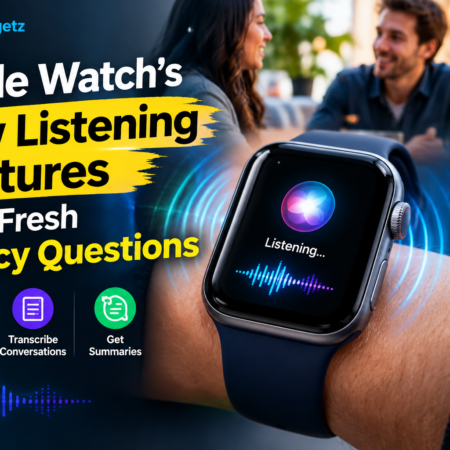
Apple is adding new capabilities to its latest Apple Watch models that could change the way users interact with conversations and information around them. The company has introduced features designed to understand nearby speech, provide short transcriptions on demand, and generate summaries that can help users remember what happened during the day.
For Apple Watch owners, these tools could be useful in situations where taking notes is inconvenient. At the same time, the idea of a smartwatch continuously processing sounds around its wearer raises an important question: what happens to other people’s conversations when only one person has chosen to use the feature?
Apple says it has designed the system with privacy in mind. According to the company’s documentation, audio is not intended to be stored as a conventional recording, and privacy protections are built into the processing system. Apple also emphasizes encryption and safeguards designed to prevent the company itself from accessing users’ private information.
Even with those protections, the technology introduces a broader social question that goes beyond data security.
The Privacy Question Goes Beyond Storage
When people have a conversation, they generally understand who is participating and why the conversation is taking place.
A discussion between friends at a restaurant is different from a business meeting, a doctor’s appointment, a classroom discussion, or a private conversation at home. In each situation, people have expectations about how their words will be used.
This idea is sometimes described as contextual integrity. In simple terms, information shared in one environment is expected to remain within the social boundaries of that environment.
Always-listening technology can challenge that expectation.
Even if a device does not permanently store an audio recording, it may still analyze speech and convert portions of a conversation into information that can later be searched, summarized, or referenced.
That makes privacy more complicated than simply asking whether an audio file exists.
Who Gets to Give Permission?
Another important issue is consent.
If an Apple Watch owner activates a feature that processes nearby speech, the person wearing the watch has made a decision to use the technology. Other people nearby may not have made the same decision.
This becomes particularly relevant in workplaces, meetings, interviews, classrooms, and other situations where conversations may contain sensitive information.
Features that visibly indicate when they are being used can make the situation easier to understand. However, continuously providing alerts every time speech is processed could also make the feature inconvenient in everyday situations.
That creates a difficult balance between privacy, transparency, and usability.
Smart Devices Are Changing Expectations
Apple Watch is not the first consumer device to raise these questions.
Smart glasses, AI-powered wearable devices, smart speakers, smartphones, and other connected products are increasingly capable of interpreting what happens around their users.
Smart glasses, for example, can potentially capture photographs or video without requiring someone to hold up a conventional camera. AI wearables can process conversations and other environmental information to provide reminders or summaries.
As these products become more common, society will have to establish new expectations about when recording or analysis is acceptable.
Some workplaces and venues have already introduced restrictions on camera-equipped wearable devices. Similar rules could eventually apply to other products capable of continuously processing their surroundings.
Apple’s Privacy Approach Matters
Apple’s approach is also worth examining separately from the broader social debate.
The company has invested heavily in privacy-focused technologies, including systems designed to process sensitive requests while limiting Apple’s own access to user information.
Apple’s Private Cloud Compute architecture is one example. The company says the system is designed so that data sent for certain processing tasks cannot be accessed by Apple, while security researchers can examine aspects of the technology.
These measures are important because privacy is not simply about whether a device has a microphone.
The more important questions are:
- What information is processed?
- Where is it processed?
- How long is it retained?
- Who can access it?
- Can the user delete it?
- Is the information shared with another service?
- Can other people reasonably know that the technology is being used?
A strong privacy system needs to address all of these questions.
Convenience Versus Privacy
There is an obvious benefit to having a wearable device that can help remember information.
Imagine attending a long meeting and later being able to review important points without manually writing everything down. A similar feature could help users remember tasks, conversations, ideas, or other information throughout the day.
For some users, that convenience may be valuable.
For others, the possibility of surrounding conversations being analyzed by a wearable device may simply be uncomfortable.
Both reactions are understandable because the technology changes an established social boundary: conversations that once disappeared naturally may now become searchable digital information.
What Should Apple Watch Users Consider?
Anyone using these features should consider the environment in which they are enabled.
Using them during personal activities may be very different from using them during a confidential meeting or professional discussion.
Users should also understand the privacy settings associated with the feature and pay attention to how Apple describes audio processing, storage, encryption, and cloud-based services.
Businesses and organizations may also need their own policies as wearable AI becomes more common.
A company that permits employees to wear ordinary smartwatches may eventually need to decide whether the same policy should apply to watches capable of analyzing conversations.
The Bigger Issue Is Trust
The debate surrounding Apple’s new Apple Watch capabilities isn’t necessarily about whether Apple is secretly recording conversations.
It is about trust and expectations.
Consumers increasingly use devices equipped with microphones, cameras, sensors, and artificial intelligence. As these devices become better at understanding their surroundings, the line between a personal assistant and an environmental monitoring device becomes less obvious.
Apple’s privacy protections can reduce some of the technical risks, but technology alone cannot determine what is socially acceptable.
That will depend on users, businesses, schools, lawmakers, and society as a whole.
Final Thoughts
Apple Watch’s newer listening and summarization capabilities demonstrate how quickly wearable technology is moving beyond notifications, fitness tracking, and basic communication.
The potential benefits are clear: users can get information without constantly reaching for their phones, and important moments can potentially be summarized automatically.
But the technology also introduces legitimate questions about consent and privacy, particularly when other people are involved in the conversation.
For Apple Watch users, the most important step is to understand how these features work and use them appropriately for the situation.
The future of wearable technology may not be determined only by what these devices can do. It may also depend on what people are comfortable allowing them to do around others.

Other Articles
9 Useful Gadgets Under 500/- For Daily Use




No Comment! Be the first one.