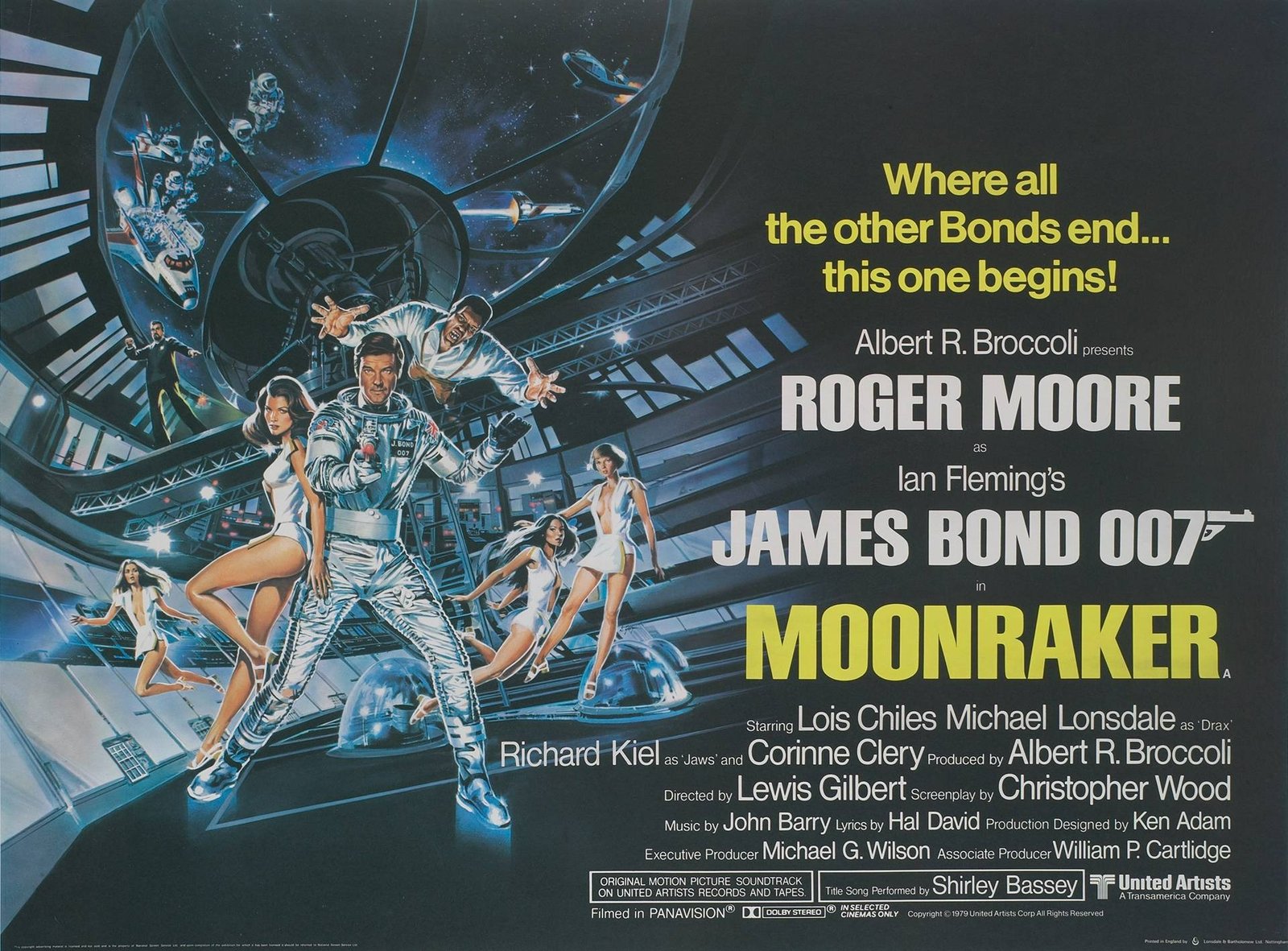
Moonraker (1979): The James Bond Film That Accidentally Predicted Today’s Billionaire Space Race
By Alex Barrientos
October 13, 2025 · 2 min read
Image Credit: 007.com
Key Takeaways
- The once-ridiculed idea of private space stations has evolved into a $150 billion industry led by SpaceX and Axiom Space.
- Virgin Galactic’s air-launch system mirrors the 1979 Bond film’s 747 shuttle concept, proving that cinematic imagination can inspire real aerospace design.
- Advances in CRISPR genetic engineering have turned Moonraker’s villainous bio-plot from impossible fiction into a modern ethical dilemma.
From Bond Villain Fantasy to Billionaire Reality
When “Moonraker” premiered in 1979, audiences saw Hugo Drax’s orbital empire as pure science fiction — a fantasy too far-fetched even for a Bond film. The idea that a billionaire could own and operate his own private space station seemed absurd, especially since NASA’s Skylab had fallen back to Earth just months before.
Fast forward to 2025, and Drax’s once-laughable dream has become a real-world business model. Companies like Axiom Space, Blue Origin, and SpaceX are investing billions in commercial orbital habitats, promising everything from space tourism to in-orbit manufacturing.
What began as a Bond villain’s delusion has become the foundation of a new space economy, valued at over $150 billion and growing.
Private Space: From Fictional Megalomania to Business Innovation
In 1979, space belonged exclusively to superpowers. The idea of private spaceflight wasn’t just unrealistic—it was unthinkable. The first Space Shuttle launch wouldn’t even occur until 1981.
Yet, Elon Musk’s SpaceX, Jeff Bezos’s Blue Origin, and Axiom Space have proven that private enterprises can lead humanity beyond Earth’s orbit. Their goal? Building self-sustaining commercial ecosystems in space — something “Moonraker” imagined nearly half a century ago.
What was once Bond villain megalomania has become venture-capital logic. Today’s entrepreneurs don’t need superpower budgets; they just need investors willing to fund humanity’s next frontier.
Air-Launched Spacecraft: From Movie Magic to Reality
One of Moonraker’s most audacious scenes showed a space shuttle launching mid-flight from a Boeing 747 — a visually thrilling but seemingly impossible stunt.
Decades later, Virgin Galactic brought that concept to life. Its SpaceShipTwo is carried by a WhiteKnightTwo mothership to 50,000 feet before igniting its rocket engine — achieving suborbital flight in precisely the same manner Bond’s film imagined.
While NASA’s actual shuttles required ground-based boosters, the air-launch concept has proven both physically sound and operationally practical for smaller missions.
Even personal flight — another Bond staple — has taken off. Companies like Jetpack Aviation and Gravity Industries now offer turbine-powered jetpacks and paramotors reminiscent of Bond’s Venice escape sequence. Personal aerial mobility isn’t quite ready for daily commuting, but the dream is alive and airborne.
The Dark Side of Moonraker’s Predictions
Not every prediction aged so gracefully.
Handheld laser weapons, a Bond favorite, remain largely fictional. Power density, heat dissipation, and battery limitations confine directed-energy systems to military vehicles, not handheld gadgets. The U.S. Navy’s LaWS program can down drones—but we’re still decades away from portable laser guns.
More disturbingly, Moonraker’s genetic engineering subplot—where Drax attempts to create a “perfect” human race—now echoes modern ethical concerns.
Thanks to CRISPR gene-editing, humanity has entered an era where targeted DNA modification is possible. What was once pure fantasy is now a bioethical battleground. The controversial 2018 gene-edited babies in China proved that the tools for Drax’s nightmare scenario already exist.
This raises urgent modern questions:
- Who regulates private genetic experimentation?
- Who governs privately owned space stations beyond Earth’s jurisdiction?
In a twist of irony, the film’s most outrageous concepts have become today’s regulatory puzzles, still waiting for their own version of 007 to bring order.
Why Moonraker Matters More Than Ever
“Moonraker” was dismissed in 1979 as over-the-top escapism — a campy detour from Cold War spy thrillers. Yet its vision of billionaire-led space colonization and engineered humanity has proven startlingly prophetic.
What once entertained audiences with laser battles and space romance now reflects the moral and political questions facing the 21st century:
- Who gets to shape life itself?
- Who owns orbit?
- And what happens when imagination outpaces regulation?
Moonraker reminds us that science fiction often foreshadows science fact — and that sometimes, villains and visionaries are separated only by ethics.