

Smartphone manufacturers have turned RAM into one of the easiest specifications to advertise.
6GB.
8GB.
12GB.
16GB.
Some phones even advertise virtual or extended RAM, making the numbers look even bigger.
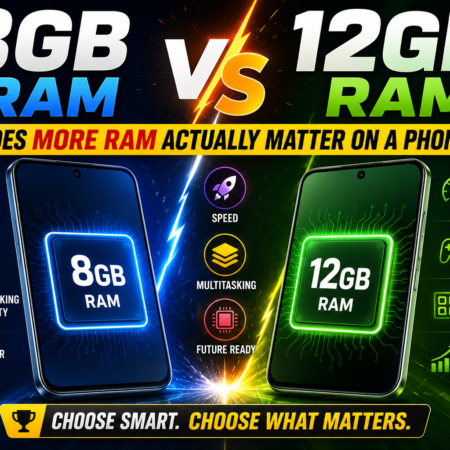
But does a 12GB smartphone actually perform twice as well as a 6GB phone?
No.
RAM doesn’t work that way.
What Does RAM Do?
RAM is short-term working memory.
When you open an application, the phone’s operating system uses RAM to keep the application and its data readily available.
More RAM can allow a phone to keep more applications in memory before needing to reload them.
This is particularly useful for multitasking.
For example, imagine you are:
- Watching YouTube
- Replying to WhatsApp
- Opening Chrome
- Checking Google Maps
- Returning to YouTube
A phone with adequate RAM can keep more of those applications available.
Is 8GB Enough?
For most people, yes.
An 8GB smartphone is generally a sensible target for a modern Android phone.
It is enough for:
- Social media
- Streaming
- Web browsing
- Messaging
- Navigation
- Banking
- Productivity applications
- Casual gaming
When Does 12GB Make Sense?
12GB can be useful if you:
- Multitask heavily
- Play demanding games
- Edit media
- Use resource-intensive applications
- Keep many applications open
- Plan to keep the phone for several years
But the improvement isn’t always obvious.
Processor Matters Too
RAM is only one part of performance.
A phone with 12GB RAM and a weak processor can still be slower than a phone with 8GB RAM and a much better processor.
Storage speed matters too.
So when comparing phones, consider:
Processor + RAM + storage + software optimization
rather than RAM alone.
What Is Virtual RAM?
Some manufacturers allow internal storage to be temporarily used as additional memory.
You may see names such as:
- Extended RAM
- Virtual RAM
- RAM Expansion
- Memory Extension
This can sound like adding physical RAM, but it isn’t the same thing.
Internal storage is much slower than actual RAM.
Virtual RAM may help in certain multitasking situations, but it shouldn’t be treated as a replacement for physical memory.
How Much RAM Should You Buy?
My general recommendation:
6GB
Fine for basic users and affordable phones.
8GB
The sweet spot for most people.
12GB
Worth considering for heavy users and people who plan to keep their phone for a long time.
16GB+
Usually unnecessary for ordinary smartphone users.
It can make sense for specialized performance-focused devices, but most people won’t see a proportional benefit.
The Hidden Problem: Software
Android manufacturers manage RAM differently.
One company’s software may aggressively close background applications.
Another may keep them alive longer.
That means two phones with the same RAM capacity can behave differently.
This is one reason specification comparisons can be misleading.
Final Verdict
If you’re choosing between an 8GB and 12GB phone and the 12GB version costs only a small amount more, it can be a reasonable upgrade.
But if the price difference is large, I’d rather put the money toward:
- Better processor
- Better camera
- Better display
- Larger storage
- Longer software support
For most smartphone buyers in 2026:
8GB is enough. 12GB is useful, but not essential.
The smartest purchase is the phone with the best overall hardware and software balance—not simply the largest RAM number.

Other Articles
AMOLED vs LCD Display: Which Is Better for Your Smartphone?


No Comment! Be the first one.