

When shopping for a smartphone, display technology is often reduced to a simple statement:
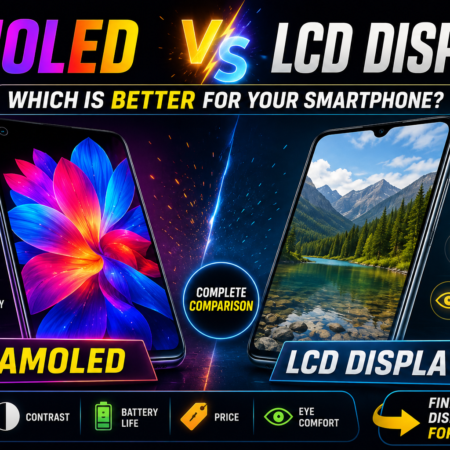
AMOLED is better than LCD.
That’s generally true in terms of contrast and black levels, but the real answer is more complicated.
A good LCD can still be enjoyable to use, while a poorly calibrated AMOLED panel can have its own drawbacks.
Let’s look at what actually separates the two technologies.
What Is an LCD Display?
LCD stands for Liquid Crystal Display.
LCD screens use a backlight behind the display layer. The pixels control how much of that light passes through.
Because the backlight is always present, displaying black is not the same as completely turning a pixel off.
This is why LCD screens generally cannot produce the same deep blacks as OLED or AMOLED panels.
What Is AMOLED?
AMOLED stands for Active Matrix Organic Light-Emitting Diode.
Unlike LCD, individual pixels can emit their own light.
This means a pixel displaying black can effectively be turned off.
The result is:
- Deeper blacks
- Higher perceived contrast
- Stronger dark-scene performance
- Potentially lower power consumption when displaying lots of black
Which Has Better Colors?
This depends on calibration.
AMOLED displays can produce extremely vibrant colors, but vibrant does not always mean accurate.
Some phones offer different display modes that let users choose between saturated and more natural colors.
A good display should not simply look colorful in a shop.
It should look comfortable over long periods.
Which Is Better Outdoors?
This depends heavily on the specific panel.
A premium AMOLED can be extremely bright outdoors.
But you should never assume every AMOLED automatically beats every LCD.
Peak brightness, screen coating, reflectivity and software brightness behavior all matter.
What About Refresh Rate?
Refresh rate is separate from display technology.
You can have:
- 60Hz LCD
- 90Hz LCD
- 120Hz LCD
- 60Hz AMOLED
- 90Hz AMOLED
- 120Hz AMOLED
A higher refresh rate generally makes scrolling and animations appear smoother.
Therefore, don’t compare AMOLED and LCD without considering refresh rate.
AMOLED Advantages
AMOLED generally wins for:
- Black levels
- Contrast
- Premium appearance
- Thinness
- Dark-mode efficiency in some situations
- High-end smartphone experience
LCD Advantages
LCD can still make sense for:
- Affordable phones
- Users sensitive to OLED characteristics
- Certain long-duration viewing situations
- Buyers who prioritize value
What About PWM?
Some OLED displays use pulse-width modulation (PWM) for brightness control.
At lower brightness levels, the screen can rapidly modulate its light output.
Some people are more sensitive to this than others.
If you have previously experienced discomfort with certain OLED displays, check independent measurements where available rather than assuming every AMOLED panel behaves identically.
Which One Should You Buy?
For a premium smartphone, I’d generally prefer a well-calibrated AMOLED.
For a budget phone, I wouldn’t reject an LCD simply because it isn’t AMOLED.
Instead, compare:
- Brightness
- Refresh rate
- Resolution
- Color accuracy
- Outdoor readability
- Viewing comfort
- Protection
- Panel quality
Final Verdict
AMOLED is usually the more premium technology, but “AMOLED” alone doesn’t guarantee a great display.
The quality of the specific panel matters more than the technology name printed on the specification sheet.
If two phones cost about the same, have similarly good panels and you prefer deeper blacks and higher contrast, AMOLED is the easy choice.
But a good LCD can still be perfectly adequate for everyday use.
In other words:
Don’t buy a display specification. Buy the display experience.

Other Articles
8GB vs 12GB RAM: Does More RAM Actually Matter on a Phone?
Best Phones Under ₹20,000 in India (2026): Top Picks Compared

No Comment! Be the first one.