

Buying a smartphone in 2026 is surprisingly complicated.
There are phones available for ₹10,000, ₹15,000, ₹20,000 and ₹50,000 that can all look impressive on paper. One model may have a 200MP camera, another may advertise a huge battery, while another focuses on a powerful processor or years of software updates.
The problem is that specifications alone do not tell you which phone is actually right for you.
A student who mainly uses WhatsApp, YouTube and Google Maps does not need the same phone as someone who plays demanding games every evening. Likewise, someone who takes lots of photographs may care more about camera processing than having the fastest processor.
This guide explains what actually matters when buying a smartphone in 2026.
1. Start With Your Budget
The first mistake many buyers make is choosing a phone before deciding how much they are comfortable spending.
Instead, establish a realistic budget.
For example:
| Budget | What you can generally expect |
|---|---|
| Under ₹10,000 | Basic everyday smartphone |
| ₹10,000–₹15,000 | Good battery, 5G and decent everyday performance |
| ₹15,000–₹20,000 | Better displays, cameras and processors |
| ₹20,000–₹30,000 | Stronger performance and better overall balance |
| ₹30,000–₹50,000 | Premium mid-range experience |
| ₹50,000+ | Flagship-level cameras, processors and displays |
These are broad categories rather than strict rules. Phone prices change frequently because of sales, new launches and discounts.
The important thing is not to spend extra money simply because a specification looks impressive.
2. Don’t Buy a Phone Just for the Camera Megapixel Number
A 108MP or 200MP camera does not automatically produce better photographs than a 50MP camera.
Image quality depends on much more than resolution.
Things such as the camera sensor, lens quality, image processing, HDR performance, stabilization and low-light processing all matter.
For everyday photography, I would pay attention to:
- Main camera sensor quality
- Optical image stabilization
- HDR performance
- Night photography
- Skin-tone reproduction
- Video stabilization
- Ultrawide camera quality
- Front-camera video quality
A phone with a well-tuned 50MP main camera can easily produce better photographs than a phone with a much higher megapixel count.
3. Processor: Don’t Obsess Over Benchmark Scores
The processor affects almost everything you do on a smartphone.
It influences application loading, gaming performance, camera processing, battery efficiency and how well the phone handles demanding applications.
But benchmark scores should not be the only reason to buy a phone.
For normal users, a modern mid-range processor is already capable of handling:
- YouTube
- Google Maps
- Banking applications
- Web browsing
- Video calls
- Office applications
- Casual gaming
Gamers should look more closely at sustained performance and thermal management.
A processor that performs extremely well for five minutes but becomes heavily throttled after prolonged gaming may not be as useful as benchmark numbers suggest.
4. How Much RAM Do You Need?
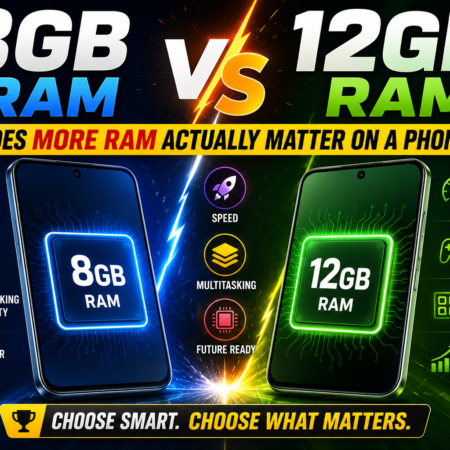
For most people in 2026, 8GB of RAM is a comfortable target.
6GB can still be perfectly usable for basic users, while 12GB or more can make sense for people who regularly multitask or use demanding applications.
However, don’t automatically pay a large premium for more RAM.
The operating system, memory management, processor and storage speed also influence how smoothly a phone behaves.
An efficiently optimized 8GB phone can feel better than a poorly optimized phone with 12GB.
5. Storage Is More Important Than Many People Think
If you take lots of photos and videos, storage can disappear surprisingly quickly.
For most buyers:
- 128GB is a reasonable starting point.
- 256GB is preferable for heavy users.
- 512GB makes sense mainly for people who store lots of large files locally.
Before buying, check whether the phone supports a microSD card.
Many modern phones do not.
If the storage cannot be expanded, buying a higher-capacity version can be worthwhile.
6. AMOLED vs LCD
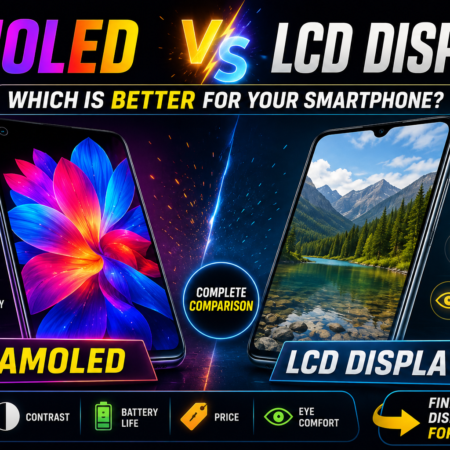
AMOLED displays generally offer deeper blacks, strong contrast and a more premium visual experience.
LCD displays can still be perfectly good, especially on affordable phones.
When comparing displays, look at:
- Panel type
- Refresh rate
- Brightness
- Resolution
- Outdoor visibility
- Color accuracy
- Touch response
Don’t assume that 120Hz automatically means a better display.
A good 90Hz or 120Hz panel with high brightness can be more pleasant to use than a poorly tuned high-refresh display.
7. Battery Capacity Isn’t the Whole Story
A 6,000mAh battery sounds better than a 5,000mAh battery, but capacity isn’t the only factor determining battery life.
Processor efficiency, display brightness, software optimization, network conditions and your usage habits all affect endurance.
If you are a heavy user, look for:
- Large battery
- Efficient processor
- Good standby performance
- Fast charging
- Reasonable thermal management
8. Fast Charging: Don’t Chase the Biggest Number
Charging speeds have become extremely fast.
You may see phones offering 33W, 45W, 67W, 80W or even higher charging speeds.
But charging speed should be viewed as convenience rather than the primary reason to buy a phone.
A reliable 45W system may be more useful to an average user than paying substantially more for an extremely high charging specification.
Also check whether the required charger is included with the phone.
9. Software Updates Matter
This is one of the most overlooked smartphone features.
A phone is not just hardware. You may use it for three, four or even more years.
Before buying, check:
- Android version
- Number of promised Android upgrades
- Security update period
- Update frequency
- Manufacturer reputation for delivering updates
Longer software support can make a slightly more expensive phone better value over time.
10. Don’t Ignore the Software Experience
Two phones with similar processors and RAM can feel completely different because of their software.
Look for:
- Clean interface
- Limited unwanted applications
- Reliable notifications
- Useful customization
- Stable updates
- Good privacy controls
- Minimal aggressive background management
A phone should make everyday tasks easier, not constantly ask you to manage unnecessary applications and notifications.
11. 5G or 4G?
In 2026, 5G is generally the safer choice if you are buying a new smartphone and expect to keep it for several years.
You don’t necessarily need the most expensive 5G modem.
But if your budget allows it, buying a 5G phone gives you greater flexibility as networks continue to develop.
12. What About AI Features?
AI has become an increasingly common smartphone feature.
Some phones now offer AI-powered photo editing, transcription, translation, summarization and writing assistance.
These features can be useful, but don’t buy a phone solely because the manufacturer uses the word “AI” repeatedly in its marketing.
Ask a simpler question:
Will I actually use these features?
If the answer is no, prioritize battery life, camera quality, software support and overall reliability.
13. Check the Build Quality
Budget phones have improved significantly, but physical construction still varies.
Look at:
- Frame material
- Display protection
- Water and dust resistance
- Button quality
- Weight
- Thickness
- Grip
A phone that feels comfortable in your hand every day can be a better choice than a slightly more powerful model that is uncomfortable to carry.
14. NFC, Stereo Speakers and Other Small Features
Small features can become important after you buy the phone.
Depending on your needs, check for:
- NFC
- Stereo speakers
- 3.5mm headphone jack
- microSD support
- IR blaster
- Wi-Fi standard
- Bluetooth version
- Dual-SIM support
- eSIM
- USB-C capabilities
Don’t assume every USB-C port provides the same capabilities. Some support faster data transfer or display output while others are primarily intended for charging and basic data.
15. Should You Buy Last Year’s Flagship?
Sometimes, yes.
A one-year-old flagship can offer:
- Better cameras
- Better build quality
- Stronger processor
- Better display
- More premium materials
However, compare software-support timelines before buying.
A discounted older flagship isn’t automatically better than a newer mid-range phone.
Final Verdict
There is no single “best smartphone” for everyone.
The right phone depends on how you use it.
For a student, battery life, software reliability and value may matter most. For a gamer, processor and sustained performance should be priorities. For a photography enthusiast, camera hardware and image processing deserve more attention.
My simplest advice is this:
Buy the phone that solves your actual problems, not the phone with the longest specification sheet.
Before purchasing, compare the processor, display, cameras, battery, software support and storage together.
A balanced smartphone will usually give you a better ownership experience than a device that has one spectacular specification and several compromises elsewhere.

Other Articles


No Comment! Be the first one.